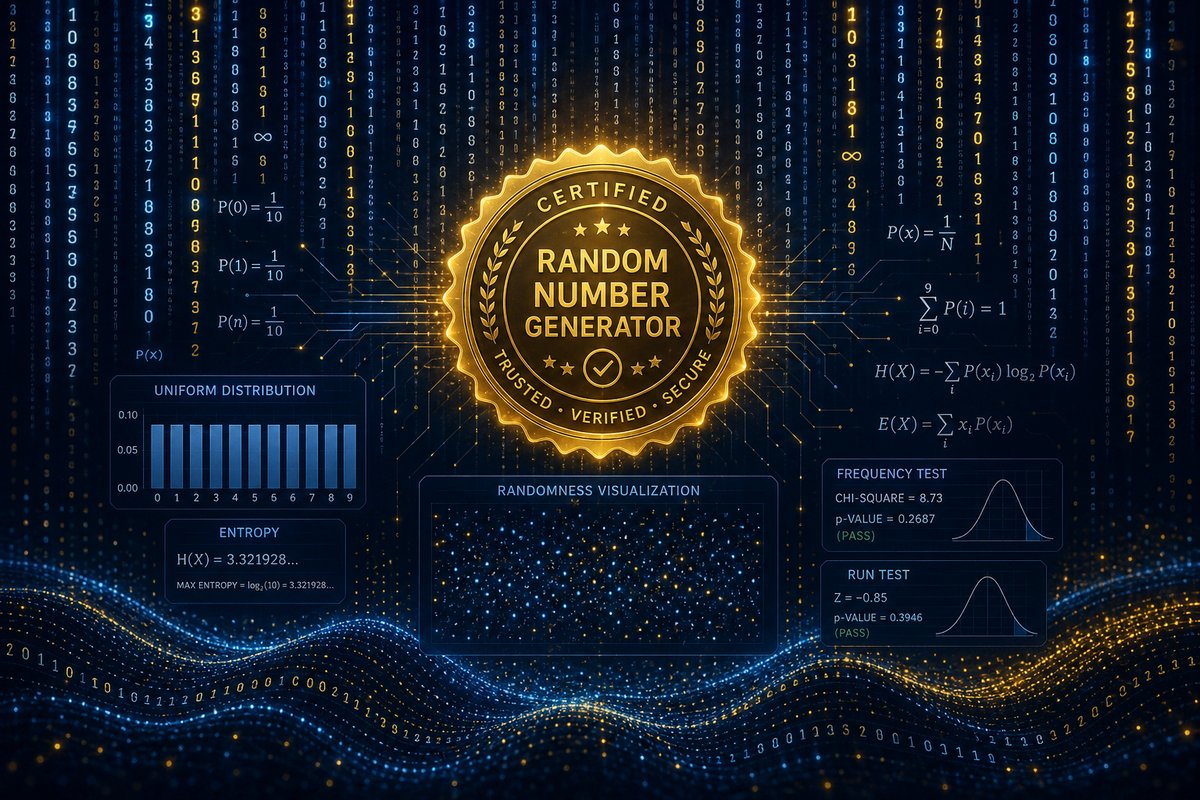
RNG & Fairness
How It Works
Random Number Generators, independent certification labs, RTP, house edge, and how the casino gaming industry guarantees fair play.
The Certification Chain
The fairness of online casino games rests on a chain of certification: software providers submit game code to independent testing laboratories, which run statistical analyses to confirm that outcomes are genuinely random and RTPs match declared values. The regulator (MGA, UKGC, etc.) accepts testing lab reports as proof of compliance before allowing games to be deployed to players.
This system means that when a player sees an RTP of 96.5% listed for a slot game, that figure has been independently verified — not just declared by the provider.
What RTP Means in Practice
RTP is a theoretical long-run statistic calculated across millions — often hundreds of millions — of simulated game rounds. A declared RTP of 96% does not mean a player will receive €96 back for every €100 wagered in a single session. In the short term, individual session outcomes vary enormously. The RTP figure only converges toward its theoretical value over an extremely large number of rounds; for any individual player, results are driven by the game's volatility profile rather than the RTP percentage alone.
RTP is certified per game configuration, not per casino. Many providers offer games in multiple RTP variants — for example, a slot may be available in 94%, 96%, and 97.5% configurations. The operator selects which configuration to deploy. Certain jurisdictions require casinos to display the active RTP for each game in their library; the UK Gambling Commission's technical standards include this requirement, and players can check the game information panel — typically accessible via an "i" button within the game client — to see the certified figure for that specific deployment.
Volatility and the Player Experience
Volatility — also called variance — describes how wins are distributed across rounds, independent of the long-run RTP. A high-volatility slot pays infrequently but delivers larger wins when they occur; a low-volatility slot pays more often but in smaller amounts. Two games with identical RTPs can produce entirely different session experiences depending on their volatility classification. Hit frequency, the percentage of spins that result in any winning combination, is a related metric that some providers publish alongside RTP and volatility ratings.
Testing laboratories verify volatility parameters as part of the certification process. The declared volatility class is cross-checked against the game's mathematical model to confirm the game behaves within the range the provider has specified. This prevents a provider from marketing a game as "medium volatility" when its actual probability distribution is that of a high-volatility title — a distinction that directly affects how players manage their bankroll.
How Players Can Verify Fairness
Players can confirm a game's certification status through several channels. Licensed casinos typically display testing lab logos in their footers; these often link to a verification portal where the operator's active certificate can be confirmed. Within the game itself, the information panel displays the certified RTP and, in many cases, a direct link to the testing lab's certificate for that specific game version and market.
Blockchain-based provably fair systems take a different approach: rather than relying on third-party auditing, they allow players to independently verify the randomness of every round using cryptographic hashing. Before a round, the server publishes a hashed seed; after the round, the original seed is revealed, and any player can confirm that the outcome was determined before the round began. This shifts verification from institutional trust in a testing lab to mathematical transparency accessible to any participant — though it applies only to platforms built on this architecture, not to conventional certified RNG systems used by mainstream casino providers.